

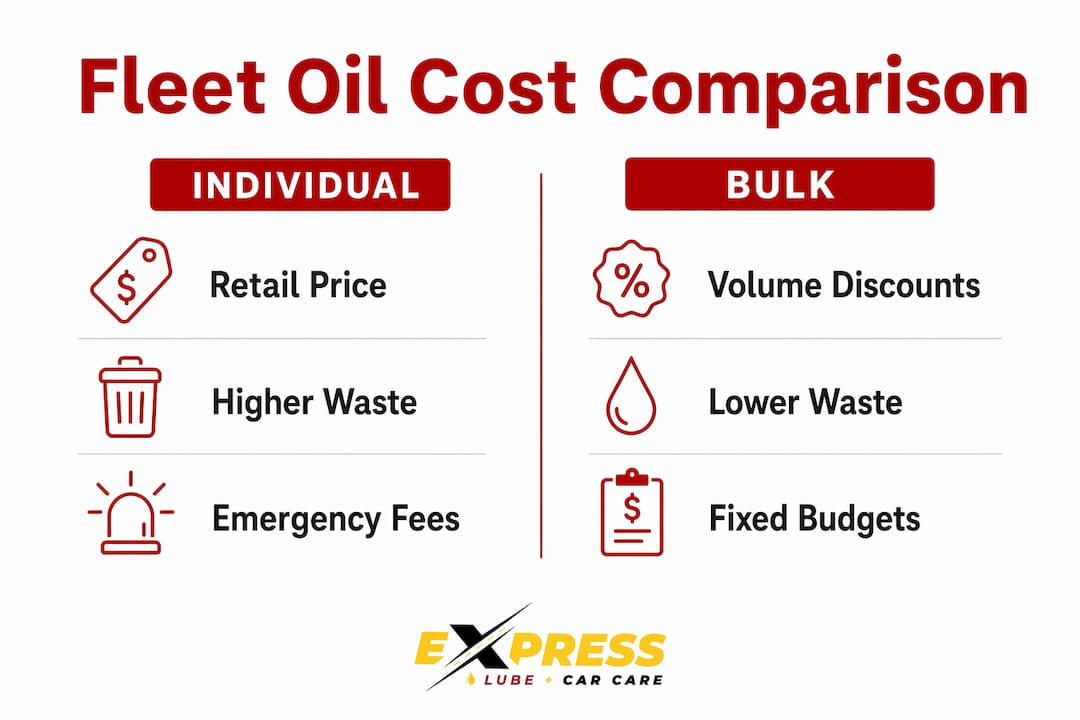
Bulk oil change discounts for fleets are cost savings passed through by service providers who purchase oil and maintenance services in massive quantities, then extend those lower rates to fleet managers. The industry standard for this volume pricing model delivers 10–25% cost reductions compared to what individual fleets pay at retail. That gap is not a promotional gesture. It reflects real operational efficiencies that providers achieve when they consolidate purchasing, scheduling, and technician deployment across hundreds of accounts. Fleet managers who understand the mechanics behind these savings make better contract decisions and capture more of the available value.
Why bulk oil change discounts work for fleets: the economies of scale
The core reason bulk oil change discounts work is purchasing volume. Third-party fleet maintenance providers buy millions of quarts of oil annually, which gives them negotiating leverage that no single fleet can match on its own. That leverage translates directly into per-unit costs well below retail market pricing.
The savings extend beyond the oil itself. Bulk operations reduce packaging waste, lower per-service disposal fees, and allow providers to order filters and drain plug gaskets in quantities that compress parts costs significantly. When a provider services 200 vehicles in a week instead of 20, the fixed overhead per vehicle drops. Consolidating work reduces overhead for providers, who pass those savings to fleets in lower rates. This is not a discount funded by cutting corners. It is a discount funded by genuine efficiency.

Cost comparison: bulk vs. individual purchasing
| Cost element | Individual purchasing | Bulk program |
|---|---|---|
| Oil cost per quart | Retail rate | Volume rate (10–25% lower) |
| Filter cost per unit | Standard parts pricing | Consolidated order pricing |
| Disposal fee per service | Per-vehicle charge | Shared bulk disposal rate |
| Technician time per vehicle | Standard labor rate | Optimized scheduling rate |
| Administrative cost per service | High (multiple vendors) | Low (single provider) |
The table above shows where savings accumulate. No single line item is dramatic. The combined effect across a fleet of 30, 50, or 100 vehicles is substantial.
Pro Tip: Ask any bulk service provider to show you their per-quart cost versus the regional retail average. A credible provider will share that number without hesitation. If they won’t, that tells you something important about the actual discount you’re receiving.
How operational efficiencies reduce the total cost of fleet oil changes
Direct price reductions are only part of the story. Fleet managers spend a significant portion of their working week coordinating oil changes across multiple vehicles, vendors, and schedules. That administrative burden carries a real cost that rarely appears on a maintenance invoice.
Third-party providers address this by consolidating scheduling, reporting, and compliance documentation into a single workflow. Instead of tracking five vendors across three locations, a fleet manager works with one point of contact. Mobile oil change services take this further by performing maintenance during off-hours, so trucks are serviced while drivers sleep rather than while they sit idle during business hours. A 50-truck fleet that recovers just one hour per service saves 175 hours of productivity annually. That is the equivalent of more than four full work weeks returned to revenue-generating activity.
The operational benefits of a well-structured bulk program include:
- Single-vendor scheduling: One call or platform manages all service appointments across the fleet.
- Consolidated reporting: Maintenance records, oil specifications, and service intervals are tracked in one system.
- Compliance documentation: Providers generate records that satisfy DOT inspection requirements and insurance audits.
- Off-hours servicing: Mobile providers work around your dispatch schedule, not their own convenience.
- Technician specialization: Providers who focus exclusively on fleet work develop faster, more consistent service processes.
Pro Tip: Choose providers that integrate with fleet maintenance software platforms. When service records flow directly into your maintenance system, you eliminate manual data entry and reduce the risk of missed service intervals.
What are the risks of bulk oil purchasing and how do you manage them?
Bulk oil purchasing carries real risks that fleet managers must account for before signing any contract. The most common mistake is ordering more oil than the fleet consumes within a reasonable timeframe. Oil degradation and contamination become genuine concerns when bulk oil sits in storage for extended periods, particularly in environments with temperature swings or humidity.
Bulk oil must be stored in clean, dry conditions with sealed containers to prevent moisture intrusion and particulate contamination. Heat accelerates oxidation, which degrades the oil’s viscosity index and additive package before it ever reaches an engine. Controlled storage conditions are not optional. They are the difference between a cost-saving program and an engine warranty problem.
A second risk involves oil specification mismatches. Mixed fleets running diesel trucks, gasoline vans, and hybrid vehicles require different oil formulations. Bulk standardization works best when a fleet runs uniform engine types. When it does not, the administrative complexity of managing multiple bulk specifications can erode the efficiency gains.
Practical steps to manage bulk oil risks:
- Match order volume to consumption: Calculate your fleet’s monthly oil consumption and order no more than a 60 to 90 day supply at a time.
- Audit storage conditions: Inspect storage areas for temperature control, moisture barriers, and container integrity before the first delivery.
- Segment by specification: If your fleet runs multiple engine types, maintain separate bulk storage for each formulation and label containers clearly.
- Start with a trial period: A 6-month to 1-year agreement lets you verify provider performance and pricing stability before committing to a long-term contract.
Pro Tip: Before committing to any bulk oil program, run a 90-day trial with a single vehicle class. Track actual consumption against projected consumption. If the numbers align, scale up. If they don’t, you’ve learned a valuable lesson at low cost.
What is the full financial impact of bulk oil change discounts for fleets?
Fleet managers who focus only on the per-quart discount miss most of the financial value in a bulk program. The full financial impact of bulk agreements includes downtime recovery, emergency premium avoidance, and administrative time savings that are often six times greater than the direct cost savings alone. That multiplier changes the ROI calculation entirely.
Predictable budgets and insurance savings
Bulk maintenance contracts convert unpredictable repair spikes into fixed, foreseeable expenses. Fleet managers can allocate capital with confidence when they know maintenance costs for the next 12 months. That predictability also signals to insurers that the fleet is well-maintained. Preventive maintenance facilitated by bulk service agreements can lower insurance premiums by 5–20%. A 50-truck fleet that saved $40,000 annually in insurance premiums from improved safety and maintenance records demonstrates how quickly those percentages compound into real dollars.
Emergency procurement and administrative cost avoidance
Fleets without bulk agreements pay emergency procurement premiums when a vehicle needs an unscheduled oil change or a filter that isn’t in stock. Those premiums are invisible in normal accounting but accumulate steadily. Bulk programs eliminate most of them by keeping parts and oil available at pre-negotiated rates. Administrative costs drop as well, because a single provider relationship replaces multiple vendor invoices, purchase orders, and approval workflows.
| Financial benefit | Standard maintenance model | Bulk program |
|---|---|---|
| Per-service oil cost | Retail rate | 10–25% below retail |
| Insurance premium impact | Baseline | 5–20% reduction possible |
| Emergency procurement cost | Frequent, unplanned | Rare, pre-negotiated |
| Administrative hours per month | High (multiple vendors) | Low (single provider) |
| Budget predictability | Low | High |
| Downtime cost per vehicle | Unmanaged | Reduced by off-hours servicing |
Pro Tip: Build a simple spreadsheet that captures all six cost categories above for your current maintenance model. Then ask a bulk provider to quote against each line. The total difference is almost always larger than fleet managers expect.
Key Takeaways
Bulk oil change discounts work because providers pass through genuine cost savings from volume purchasing and operational efficiency, not arbitrary markdowns.
| Point | Details |
|---|---|
| Volume pricing drives discounts | Providers buy millions of quarts annually, securing rates 10–25% below retail for fleet clients. |
| Operational efficiency multiplies savings | Consolidated scheduling and off-hours servicing recover productivity that direct discounts alone cannot capture. |
| Storage and specification risks are real | Match order volume to consumption and store oil in controlled conditions to protect quality. |
| Full ROI exceeds direct discounts | Downtime recovery, insurance savings, and administrative cost avoidance can be six times the direct price reduction. |
| Trial periods protect fleet managers | A 6-month to 1-year agreement lets you verify provider performance before committing long term. |
What fleet managers often get wrong about bulk oil programs
Fleet managers at Express Lube & Car Care have seen the same pattern repeat itself: a fleet operator signs a bulk agreement, looks at the per-quart savings, and declares the program a success without ever measuring the full return. That approach leaves most of the value on the table.
The real discipline in a bulk oil program is treating it as a fleet maintenance cost savings system, not a purchasing discount. That means tracking downtime hours recovered, monitoring insurance premium changes after 12 months of documented maintenance, and measuring how much administrative time your team reclaims when a single provider handles scheduling and reporting. Those numbers tell the true story.
The other mistake is locking into a long-term contract before validating the provider. A provider who performs well on 10 vehicles may struggle with 80. Starting with a short agreement and scaling up after proven performance protects your fleet from service gaps that cost far more than any discount saves. The providers worth working with will welcome that approach. They know their own capacity.
— Express Lube & Car Care
Fleet oil change programs at Express Lube & Car Care
Express Lube & Car Care works with fleet managers in the Plano area who need reliable, cost-effective maintenance without the scheduling headaches that come with managing multiple service vendors.
Certified technicians handle oil changes, brake inspections, and engine services with no appointment required, so your vehicles get serviced when it fits your dispatch schedule. Fleet accounts benefit from competitive pricing on oil change service specials and consolidated service records that simplify compliance documentation. The fleet maintenance program at Express Lube & Car Care is built around predictable pricing and fast turnaround, giving fleet managers the cost control and uptime they need to keep operations running.
FAQ
How much can a fleet save with bulk oil change discounts?
Third-party providers typically deliver 10–25% savings on per-service oil costs compared to retail purchasing. When downtime recovery and administrative savings are included, the total financial benefit is often six times the direct discount.
What oil storage conditions are required for bulk programs?
Bulk oil must be stored in clean, dry environments with sealed containers to prevent moisture intrusion and oxidation. Heat and humidity accelerate oil degradation, which can negate the cost savings from bulk purchasing.
How long should a trial period be before committing to a bulk contract?
A 6-month to 1-year agreement gives fleet managers enough time to verify provider capacity, pricing consistency, and service quality before signing a long-term contract.
Can bulk oil programs work for mixed fleets with different engine types?
Yes, but they require careful management. Different engine types need specific oil formulations, so mixed fleets must maintain separate bulk storage for each specification and confirm the provider can handle multiple oil grades.
Does preventive maintenance through bulk programs affect insurance costs?
Documented preventive maintenance can lower fleet insurance premiums by 5–20%. Insurers view consistent, well-documented maintenance records as evidence of lower risk, which translates into measurable premium reductions.