

If your parking brake is stuck, start with the basics: keep your foot firmly on the brake pedal, release the lever, pedal or switch fully, and check that the dash warning light goes out. If it does not release, do not force it and do not drive on it. A brake that drags can overheat and wear out fast, and a forced cable can snap. A few gentle, low-risk steps are below. If they fail, the next step is a professional inspection.
This guide covers why a parking brake sticks, what you can safely try in a driveway or parking lot, the warning signs that mean you should stop, and what repairs usually involve. It applies to a traditional lever or foot pedal and, where noted, to an electronic parking brake (EPB). Procedures differ by vehicle, so your owner’s manual always comes first.
TL;DR
- Release the brake with your foot on the brake pedal, then confirm the warning light goes out. If it stays on, something is wrong.
- Gentle moves are fine: cycle the lever or pedal a few times, or rock the vehicle slightly. Forcing the lever or hammering an EPB button is not.
- Do not drive with a brake that is dragging or a light that stays on. Driving with it engaged can overheat the system and cause early wear or damage.
- A broken cable, heavy rust, a burning smell or an EPB that will not release means it is time for a professional.
- Repair costs vary widely by vehicle and by what failed, from a simple adjustment to a motor or cable replacement.
Table of Contents
- Why a Parking Brake Gets Stuck
- Signs the Parking Brake Is Sticking or Dragging
- What to Try First (Safely)
- What Not to Do
- If the Cable Is Frozen
- Electronic Parking Brakes: A Different Playbook
- When to Stop and Call a Professional
- What a Repair Usually Involves
- How to Keep a Parking Brake From Sticking
- Our Perspective on a Stuck Parking Brake
- Get It Looked At in Plano
- FAQ
- Sources
Why a Parking Brake Gets Stuck
A parking brake is a separate, mechanical path to your rear brakes. On most cars a cable runs from the lever or pedal to each rear wheel. Pull the lever and the cable tightens, pressing shoes against a drum or working a mechanism in the caliper. Anything that keeps that cable or those parts from moving can leave the brake applied.
The common causes:
- Corrosion and rust. Cables, pivot points and shoe hardware rust over time. AutoZone lists corroded cables, lack of lubrication, a seized caliper, infrequent use, frozen moisture and road debris among the usual causes.
- A cable stuck inside its sheath. Car Talk notes that a cable can feel tight yet be seized inside its housing, and that hidden pivot levers, equalizer bars and shoe mechanisms can rust too.
- Shoes or pads stuck to the drum or rotor. This often follows long periods of sitting, heavy wear or a seized caliper.
- Infrequent use. Parts that never move tend to seize. Many drivers rarely touch the parking brake, particularly on automatics.
- Frozen moisture. Water in the cable housing can freeze overnight and hold the brake on.
- Electronic faults. An EPB can fail through a blown fuse, a faulty switch, a worn motor or a sensor problem.
A stuck caliper is a related but separate problem. If your parking brake is fine but a wheel drags or smells hot, read our guide to a stuck brake caliper.
Signs the Parking Brake Is Sticking or Dragging
Sometimes the brake is not obviously stuck. It is just not fully letting go. AutoZone lists these symptoms: a lever or pedal that feels unusually tight or loose, a vehicle that strains or will not move in gear, a burning smell, and a parking brake light that stays on or flashes.
Other things to watch for:
- The car feels sluggish or pulls to one side when you pull away.
- One rear wheel is noticeably hotter than the other after a short drive.
- A grinding or scraping sound from the rear.
- The lever drops back to its rest position but the car still feels held.
If you notice any of these after you have released the brake, treat it as a stuck brake, even if the lever looks free.
What to Try First (Safely)
These steps are low-risk. Stop at any point where something feels wrong, or where you would need to use real force.
1. Release it the correct way
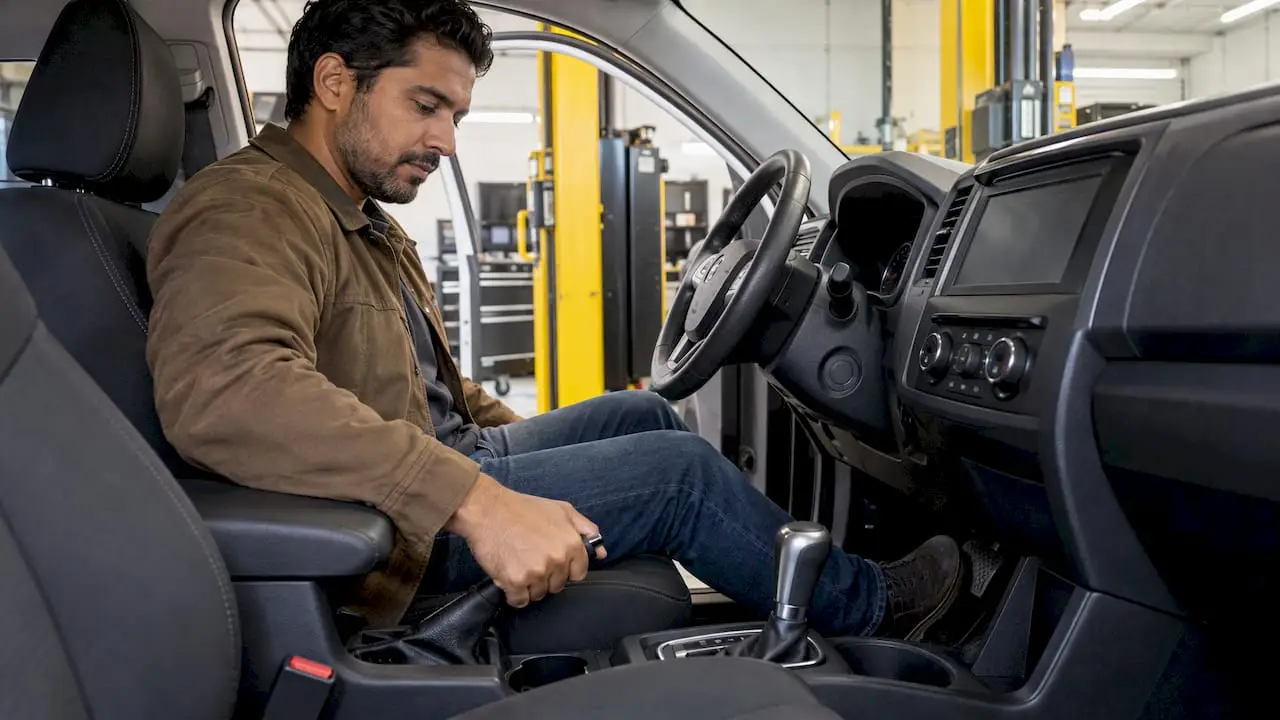
Sit in the driver’s seat with your foot firmly on the brake pedal. Kia’s owner guidance describes releasing the parking brake with the foot on the brake pedal and confirming the warning light goes off. On a lever, pull up slightly, press the button and lower it fully. On a foot pedal, use the release handle and make sure the pedal returns all the way. Check the owner’s manual for your model, because release procedures differ.
2. Apply and release a few times
A stuck cable sometimes frees up after a few gentle cycles. Apply the brake, release it, and repeat a handful of times. This can break loose light corrosion or a shoe that is stuck lightly to the drum. Use normal pressure, not a yank.
3. Check the shifter position
Make sure the transmission is fully in Park or Neutral. Pressure from the vehicle’s weight, especially on a slope, can load the parking mechanism and make release feel stiff. Having a passenger or a short, safe nudge from the transmission can relieve that load. Do this only on level ground with nobody near the vehicle.
4. Rock the vehicle gently
On flat, clear pavement, with the brake released as far as it will go, shift between Drive and Reverse using light throttle. The small back and forth movement can break shoes loose from a drum. Keep it to a few slow cycles. If the car resists strongly or you hear scraping, stop.
5. After it frees up, confirm it is really free
Once a stuck brake lets go, cycle the lever or pedal a few more times before you drive off. Cycling confirms the shoes fully release rather than just dragging. Then drive a short distance at low speed and feel for drag, pulling or a burning smell. If anything seems off, have it checked.
What Not to Do
- Do not force the lever or stomp the pedal release. Hard force strains the cable or motor and can snap a cable or burn out an actuator.
- Do not keep pressing the EPB button. Repeated presses will not push a motor through ice or a mechanical jam.
- Do not drive with a brake that is dragging. Heat builds quickly and can damage the pads, shoes, rotors or drums.
- Do not use an open flame to thaw a cable. Heat from a torch can damage rubber boots, melt brake lines or ignite grease near the brakes.
- Do not spray lubricant on friction surfaces. Oil on pads, shoes or rotors reduces braking power. Any lubricant belongs on external cable housing only.
- Do not crawl under a vehicle held by a jack. Brake work needs proper stands and the right know-how, which is one reason to hand the job to a shop.
If the Cable Is Frozen
Freezing weather is a less frequent problem in North Texas than in colder states, but a hard freeze after wet weather can still lock a cable, especially in a vehicle that sat parked overnight. The signs are a brake that was fine the day before and will not release on a cold morning.
What tends to work:
- Let the engine run for several minutes. Warmth from the engine and exhaust can warm the underbody and melt ice.
- Apply gentle heat. A hair dryer or heat gun, kept moving, directed near the cable and each rear wheel is a common approach. AutoZone suggests focusing on cable connections and rear brakes while gently testing the release and avoiding heavy lever force. Avoid pouring hot water, which can refreeze.
- Cycle the brake gently once it moves, as described above.
- Stop if it will not budge. If a reasonable warm-up does not free it, leave the vehicle parked and call for help rather than driving on a locked brake.
A habit that prevents the problem: when it is freezing, wet or snowy, AAA advises skipping the parking brake and using Park, a gear or wheel chocks instead. On an automatic, Park alone holds the vehicle on level ground, though your manual may recommend using both on a slope.
Electronic Parking Brakes: A Different Playbook
Many newer vehicles use a switch instead of a lever. These systems rely on a motor and electronics, so the manual-release tricks above often do not apply.
If an EPB will not release:
- Check the dash light. A parking brake or brake warning light that stays on after release points to a fault. Kia’s guidance says a warning light that remains on after release indicates a brake system malfunction needing immediate attention.
- Make sure the battery is healthy. A weak battery can cause odd electronic behavior. If your car has been slow to start, a battery, alternator and starter check can rule it out.
- Do not repeatedly press the switch.
- Follow the owner’s manual. Procedures differ by make. Kia’s U.S. manual says that when an EPB does not release normally, the vehicle should be loaded onto a flatbed tow truck and taken for inspection. Other makers may give their own steps, so check yours.
EPB faults commonly trace to a fuse, switch, motor or sensor, and diagnosing them takes a scan tool and a brake inspection.
When to Stop and Call a Professional
The goal of any DIY step is to avoid damage, not to win a fight with the brake. Stop and get help when:
- The brake does not release after the gentle steps above.
- You find a broken or frayed cable, heavy rust or damaged brake parts. AutoZone advises seeking professional help in those cases.
- A burning smell, smoke or a very hot wheel appears.
- The brake warning light stays on or flashes.
- The vehicle strains or will not move in gear.
- You have an EPB that will not release.
- You drove a short way and the car feels like it is dragging.
If the car cannot be moved safely, arrange a tow instead of driving it. A dragging rear brake can glaze pads or warp a rotor, turning a small repair into a bigger one.
A stuck parking brake can also appear together with other brake concerns. If your pedal feels odd, our guides to a soft brake pedal and a hard brake pedal explain what to check, and a brake warning light may point to a different issue than the parking brake itself.
What a Repair Usually Involves
The fix depends on what is actually stuck. After an inspection, a technician may find one of the following:
| Finding | Typical repair |
|---|---|
| Rusted or dry cable or joints that can be reached | Cleaning and lubricating, then testing |
| Rear drum shoes out of adjustment | Readjusting the shoes |
| Seized or frayed cable | Cable replacement |
| Worn or stuck shoes or pads | Shoe or pad replacement, often with a drum or rotor check |
| Seized caliper mechanism | Caliper service or replacement |
| EPB fault | Fuse, switch, sensor or motor diagnosis and repair |
AutoZone notes that accessible corroded cables or joints may be treated with lubricant, while rear-drum adjuster work can leave the brakes out of adjustment and needing readjustment before normal driving. That is a good example of why this job is better left to a shop than done in a hurry.
What it may cost
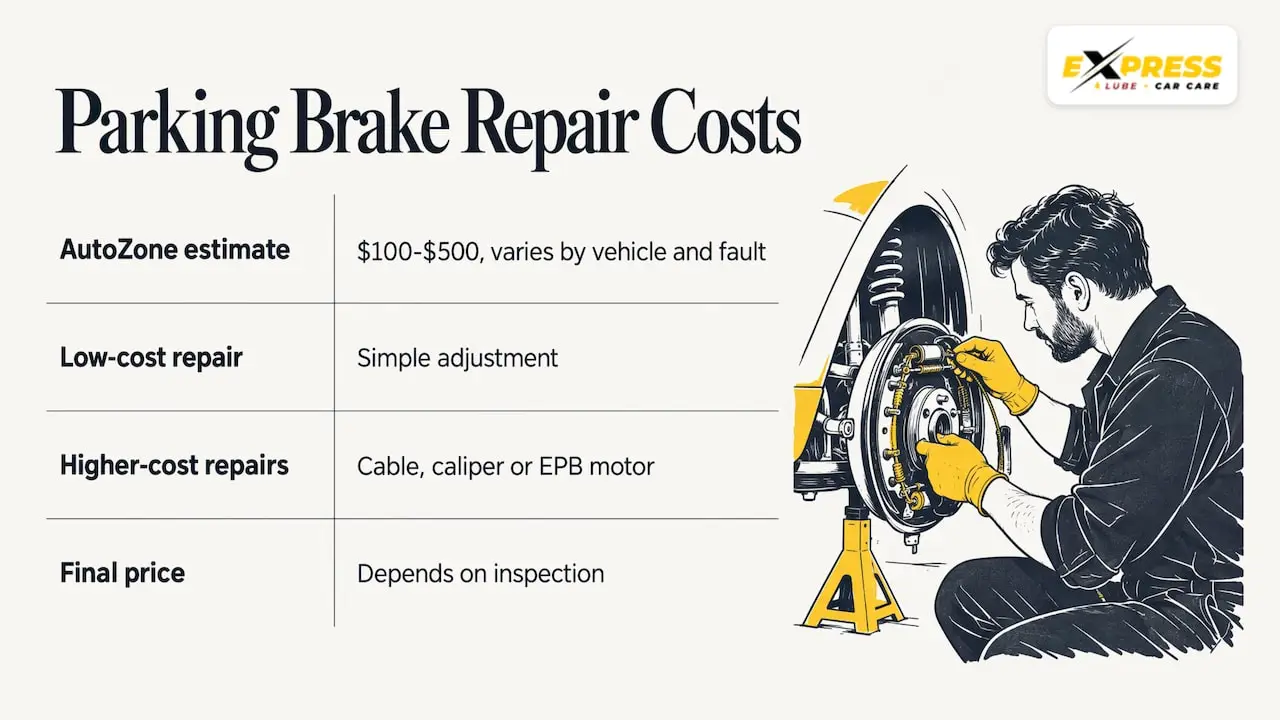
Costs depend on your vehicle, what failed and local labor rates. AutoZone estimates roughly $100 to $500 depending on the problem and the model. A simple adjustment sits at the low end, and a cable, caliper or EPB motor repair sits higher. We do not publish fixed prices for this repair because the right number depends on what the inspection finds, so we give you an estimate after we look at your vehicle.
The parking brake is also a regulated safety system. Federal standard FMVSS 135 requires a friction-type parking brake held by solely mechanical means, tested on a 20% grade. That standard governs how manufacturers build the system. It is not a release procedure, but it is a reminder that the parking brake is meant to hold a vehicle reliably, and a repair should restore that.
How to Keep a Parking Brake From Sticking
Most sticking comes from neglect. A few habits help:
- Use it regularly. Applying it now and then keeps the cables and shoe hardware moving, if your manual allows it.
- Do not leave it on for long periods in wet weather, and avoid it in freezing conditions.
- Apply it firmly but not violently. Over-tightening can strain the cable.
- Wash and inspect after mud, salt or standing water. Debris and road grime speed up corrosion.
- Ask for a brake inspection during routine maintenance. Your rear brakes, cables and fluid are easy to check during an oil change, and a brake service typically covers inspection of the pads, rotors and hardware.
- Pay attention to early signs like a tight lever, a longer pedal travel or a light that flickers. Maintenance intervals and needs vary by vehicle, so follow your manufacturer’s schedule.
If the pads and rotors are worn, other symptoms usually show first. Our guides on signs you need new brakes and what a grinding noise when braking means can help you catch problems early.
Our Perspective on a Stuck Parking Brake
We see the same pattern often: a driver tries a few things, gets the brake to let go, and drives away. Then the problem returns, or a rear wheel quietly drags for weeks until the pads or rotor pay for it.
Our view is that a stuck parking brake is a symptom, not the whole problem. The question is why it stuck. A cable that has seized, a shoe that is out of adjustment and an electronic fault each need a different fix, and guessing wastes time and money.
That is why we lean on a proper inspection. Our ASE-certified technicians look at the cables, the rear brake hardware and the warning system, and our digital vehicle inspections give you photos and technician notes so you can see what we see. We do not need an appointment for most work, so you can bring the vehicle in when it happens, not days later.
Qualifying repairs we perform carry our 24-month/24,000-mile limited warranty, whichever comes first. Eligibility, limitations and exclusions apply, and not every repair or part is covered, so we will explain what applies to your job before you decide.
Express Lube & Car Care
Get It Looked At in Plano
If your parking brake is stuck, or it released but the car still feels like it is dragging, we can inspect the rear brakes, cables and warning system and tell you what we find before any work begins. We serve drivers in Plano and Collin County with no appointment needed, and we offer discounts for military and healthcare providers.
See our brake repair and service page, browse all our services, or check the current brake service coupon before you visit. If the vehicle will not move safely, arrange a tow rather than driving it in.
FAQ
Is it safe to drive with a stuck parking brake?
Generally, no. A parking brake that stays partly applied can overheat the braking system and cause early wear or damage, as Kia’s owner guidance warns. If the warning light stays on after release, have the vehicle inspected before driving it any distance.
How do I manually release a stuck parking brake?
With your foot on the brake pedal, release the lever, pedal or switch fully, then apply and release it a few times. On a flat, clear surface you can also rock the vehicle gently between Drive and Reverse. Do not force the lever or hit an electronic button repeatedly, and check your owner’s manual for your model’s release steps.
What causes a parking brake to lock up?
The usual causes are rusted or seized cables, shoes or pads stuck to the drum or rotor, a seized caliper, infrequent use, frozen moisture and road debris. Electronic systems can also fail through a fuse, switch, motor or sensor. AutoZone’s guide covers these in more detail.
How much does it cost to fix a stuck parking brake?
It depends on what failed. AutoZone puts the range at about $100 to $500, depending on the issue and vehicle. An adjustment costs less, while cables, calipers and electronic parts cost more. A brake inspection gives you a real estimate for your vehicle.
Can a stuck parking brake drain my battery or leave me stranded?
A mechanical brake that is stuck will not drain the battery, but it can stop the car from moving and damage the brakes if you push through. On an EPB, a weak battery can cause release problems, so a battery check is worth doing. If the car will not move, call for a tow.
Sources
- My Parking Brake is Stuck, AutoZone
- Emergency Brake Issues May Be More Than Meets the Eye, Car Talk
- Introduction, Kia 2025 owner’s manual (Canada)
- When the EPB is not released, Kia 2023 owner’s manual (U.S.)
- Parking Brake Frozen in Winter: Causes and Fixes
- 49 CFR 571.135, Standard No. 135, eCFR