
If you're driving an older car around Plano, you probably feel it every time you stop for gas. A truck from the early 2000s, a well-kept sedan from the 1990s, or a classic weekend car can still be dependable, but many older vehicles slowly lose fuel efficiency in ways owners don't notice until the tank starts emptying faster than it used to.
The good news is that better mileage usually doesn't come from one magic fix. It comes from stacking the right small wins. Some are basic maintenance jobs you can handle in your driveway. Others need proper diagnostic tools and a trained eye. The trick is knowing which jobs help, which ones only help certain engine types, and which upgrades are worth paying for.
A lot of advice online treats every older car the same. That doesn't work. A carbureted classic responds differently than a fuel-injected commuter. A car that spends its life on Central Expressway has different needs than one that only sees short neighborhood trips. If you want to know how to improve fuel efficiency in older cars, start with the fixes that return the most value for the time and money you put in.
The High Cost of Low MPG Why Your Older Car Drinks Fuel
A lot of Plano drivers are holding on to older cars for good reason. The vehicle is paid off, parts are available, and the car still does what it needs to do. Then fuel prices climb, traffic gets heavier, and that dependable car starts feeling expensive to feed.
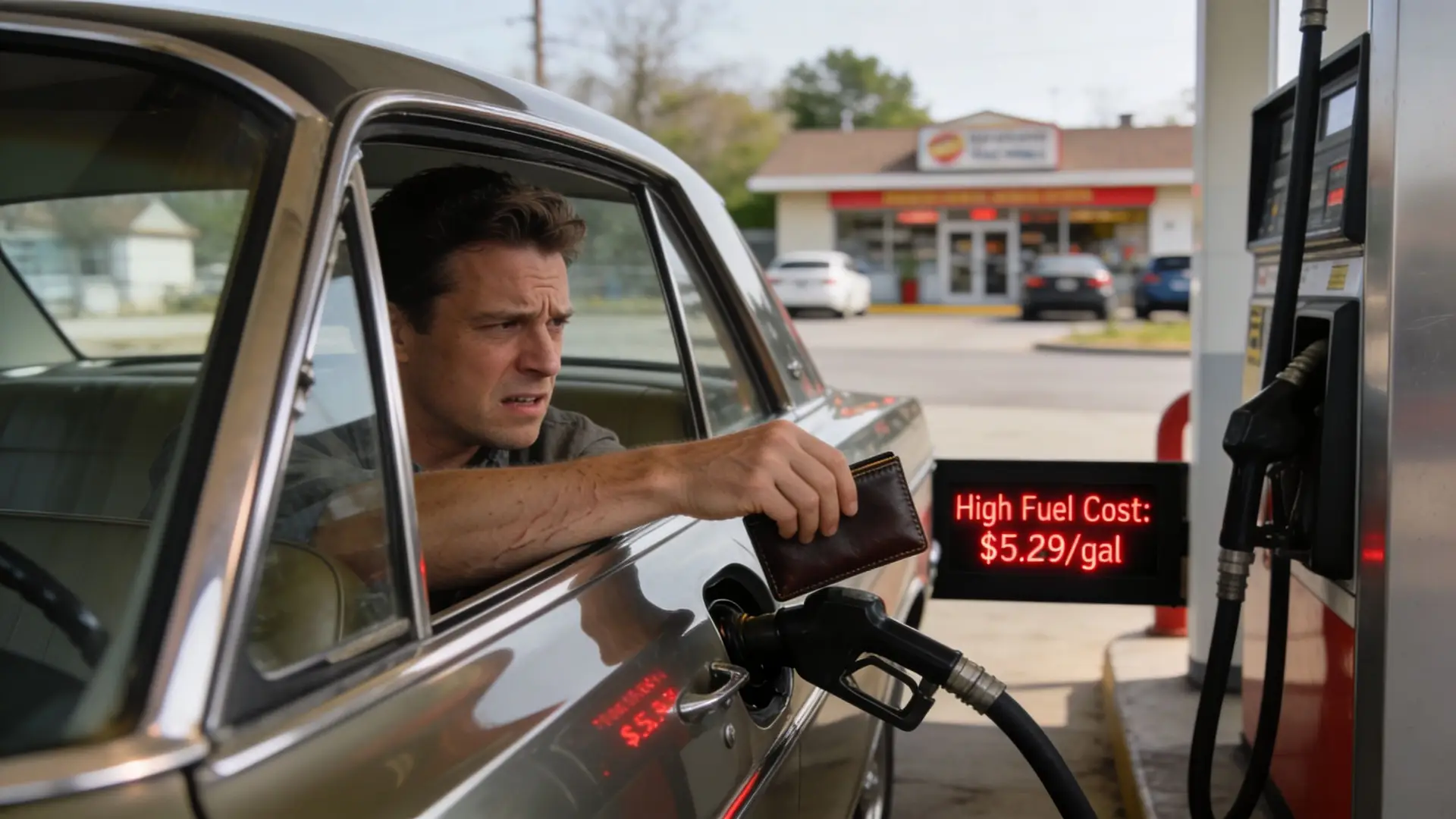
Older cars usually burn more fuel for a few simple reasons. Parts wear down. Sensors get lazy. Ignition components don't fire as cleanly as they once did. Tires drag more than they should. Fluids age. Even when the car still "runs fine," it may be using more fuel than necessary to do the same work.
Why age changes fuel economy
Fuel efficiency drops when several small problems pile up at once.
- Engine wear adds friction: Internal parts don't move as smoothly when oil is old, deposits build up, or tune-up parts have aged.
- Older systems have less adjustment range: Many older vehicles can't compensate for wear as well as newer ones.
- Local driving is hard on mileage: Plano traffic, long lights, hot weather, and repeated short trips all punish older engines more than steady open-road driving does.
- Maintenance gets delayed: Owners often put off small jobs because the car still starts and drives. That's usually when mileage begins to slide.
Older cars rarely lose fuel economy from one dramatic failure. Most of the time, they lose it from a dozen minor issues nobody has corrected yet.
The encouraging part
You don't have to replace the car to improve it. Start with fundamentals. Check the items that create drag, wasted fuel, or weak combustion. Then decide whether the next step should be a simple DIY task, a service visit, or a more serious upgrade.
That practical approach works better than chasing gimmicks. Fuel additives, trendy bolt-ons, and internet myths get a lot of attention. Solid maintenance and the right targeted repairs do more.
The Foundation of Fuel Economy Essential Engine Maintenance
When an older car starts using more gas, I don't start with fancy upgrades. I start with the basics that affect combustion, friction, and airflow. That's where the greatest gains usually are.
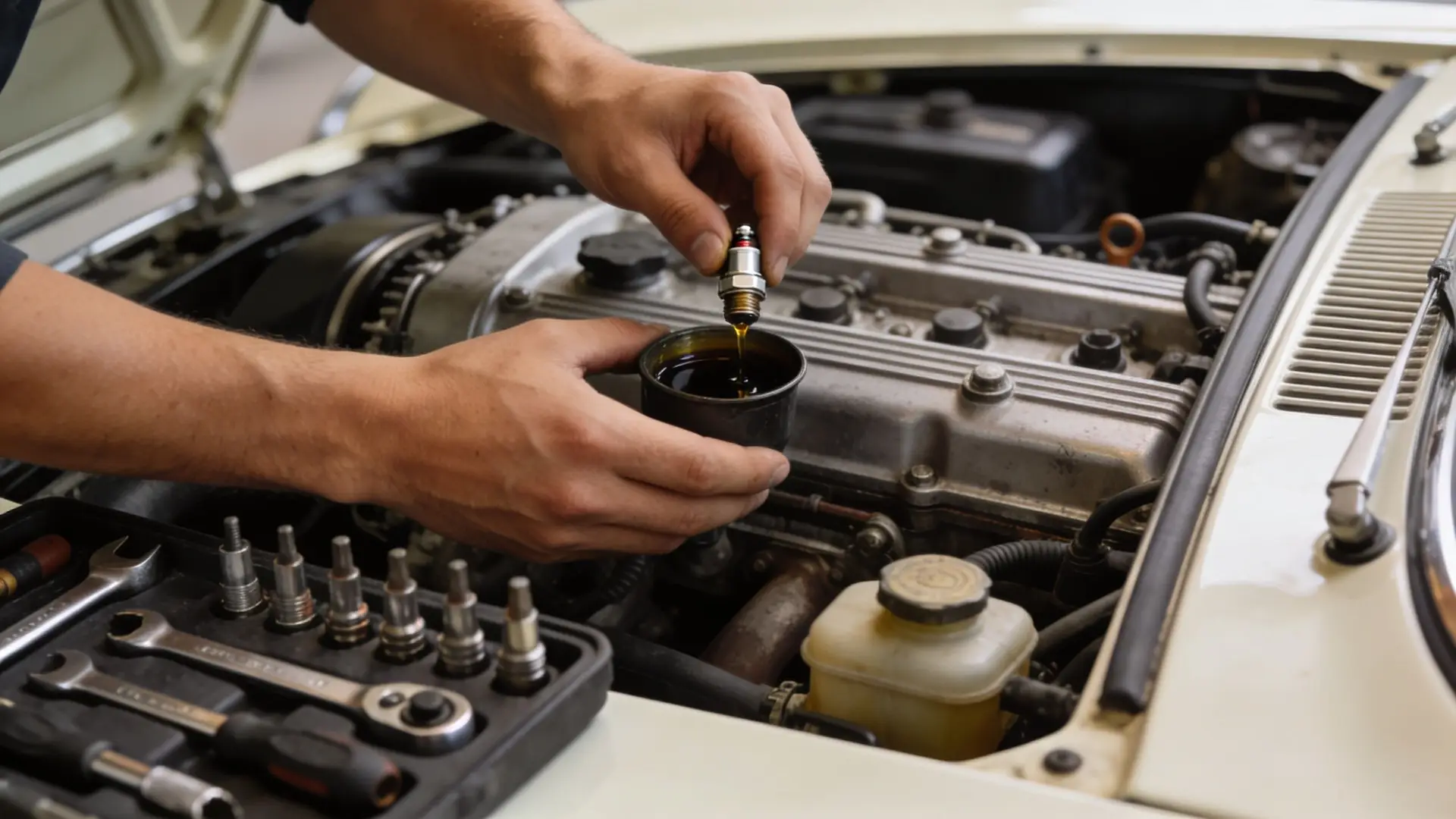
Start with the maintenance your engine actually needs
Every older engine depends on clean oil, a healthy ignition system, and correct service intervals. If any of those are behind, fuel economy suffers.
A basic fuel-efficiency check should include:
- Motor oil condition and viscosity: Use the correct oil grade for the vehicle. Clean oil reduces internal friction and helps the engine move easier.
- Spark plugs and ignition parts: Worn plugs can weaken combustion and waste fuel.
- Fluid condition: Dirty or low fluids increase resistance and can affect how smoothly the drivetrain operates.
- Fuel and air metering components: On older vehicles, even mild contamination can throw off the way fuel gets delivered.
A lot of owners skip straight to "upgrades" before doing these basics. That's backwards. An engine with old plugs and neglected maintenance won't reward you for chasing advanced modifications first.
The air filter myth that wastes money
This is one place where older-car advice gets oversimplified.
According to the U.S. Department of Energy guidance summarized in this fuel economy publication, replacing a dirty air filter can improve fuel economy by 2% to 6%, with gains up to 14% if severely clogged, but only on pre-1980s carbureted engines. On fuel-injected vehicles common since the early 1980s, a fresh air filter can improve acceleration, but it doesn't improve fuel economy.
That matters. If you're driving a 1990s or 2000s fuel-injected car, changing the air filter is still good maintenance, but don't expect it to fix poor mileage by itself.
Myth check: A new air filter is not a universal MPG fix. It helps carbureted older cars much more than fuel-injected ones.
If you want a simple explainer on replacement timing and symptoms, this guide on how often you should change your air filter is useful for sorting out maintenance needs from fuel-economy expectations.
Match the repair to the engine type
Good diagnosis is how money is saved.
A carbureted older car may respond well to air-filter service and carb tuning. A later fuel-injected car often benefits more from spark plug inspection, fuel-system diagnosis, and checking sensors or airflow measurement issues. That's why broad internet lists can lead owners to spend money in the wrong place.
For drivers who like learning the basics before touching the car, a structured overview of vehicle maintenance in Florida gives a helpful maintenance mindset that applies anywhere, including here in Texas. The climate is different, but the logic is the same. Understand the system before replacing parts.
What to inspect before blaming the engine
Before you assume the engine itself is tired, look at the service items around it.
Read the service history
If you don't know when the plugs, filters, or fluids were last serviced, start there.Watch for symptoms under load
Hesitation, rough idle, sluggish throttle response, or hard starts often point to maintenance issues that also hurt mileage.Check for obvious neglect
Oil sludge, damaged ignition wires, or visible vacuum-hose problems can all contribute.
The video below gives a useful visual walk-through of maintenance checks that often affect how an older engine runs.
Cost-benefit view of basic engine maintenance
| Maintenance item | DIY friendly | Fuel economy impact | Best use case |
|---|---|---|---|
| Correct oil and filter service | Yes | Helps restore lost efficiency when overdue | Any older car |
| Spark plug inspection or replacement | Sometimes | Often worthwhile when plugs are aged or misfiring | Older gasoline engines |
| Air filter replacement | Yes | Helpful for carbureted engines, not an MPG fix for most fuel-injected cars | Engine-type specific |
| Visual vacuum and hose check | Yes | Helps catch wasteful drivability issues early | High-mileage vehicles |
If your goal is to improve mileage without throwing money at guesses, this is the foundation. Get the engine running clean and consistent first. Then move to tires, alignment, driving habits, and only after that, bigger upgrades.
Rolling Resistance and Alignment A Straight Path to Savings
A lot of fuel gets wasted before it ever reaches the engine's hard parts. It gets lost at the road. Tires that are low on pressure or wheels that aren't pointed straight make the car work harder every mile.
Tire pressure is a fuel economy item
The U.S. Department of Energy says keeping tires inflated to proper pressure can improve gas mileage by an average of 0.6%, with potential gains up to 3%, according to its gas-saving guidance. The same source notes that under-inflated tires lower fuel economy by about 0.2% for every 1 psi drop in average pressure.
That's not theory. You can feel it in how the car rolls. Low tires flex more, build more heat, and create more rolling resistance. Your engine burns more fuel just to overcome that drag.
Where to find the correct pressure
Don't use the number molded into the tire sidewall as your target. That's a maximum rating, not the everyday setting for your vehicle.
Look in one of these places:
- Driver's door jamb: Usually the first and best place to check
- Glovebox label: Common on some older models
- Owner's manual: Good backup if labels are missing
Plano weather makes this more important. Heat, cooler mornings, and seasonal swings can change tire pressure enough to affect how the car drives and how much fuel it uses.
Practical rule: Check tire pressure when the tires are cold. If you only look when a tire appears low, you're already behind.
Alignment matters more than many drivers think
A car with poor alignment doesn't roll cleanly. It scrubs across the road. Sometimes it's obvious because the steering wheel sits crooked or the car drifts. Sometimes it's subtle, and the only clue is tire wear or a mileage drop.
Alignment problems also create a false diagnosis cycle. Drivers think the engine is getting weak, replace parts under the hood, and still don't like the mileage because the car is fighting itself on the road.
If you're unsure what to look for, these signs your car needs alignment give a solid checklist before tire wear gets expensive.
The best routine for most older cars
Treat tires and alignment as regular fuel-economy maintenance, not occasional cleanup work.
| Check | What to do | Why it helps |
|---|---|---|
| Tire pressure | Compare all four tires to the vehicle spec | Reduces rolling resistance |
| Tread wear | Look for uneven inner or outer wear | Helps catch alignment issues early |
| Steering feel | Notice pulling, off-center wheel, or vibration | Flags wasteful drag |
| Alignment service | Have it checked if symptoms show up | Keeps the car tracking straight |
Low tire pressure is one of the simplest things to fix on an older car, and alignment is one of the easiest issues to overlook. If you want better mileage, don't leave your fuel savings at the contact patch.
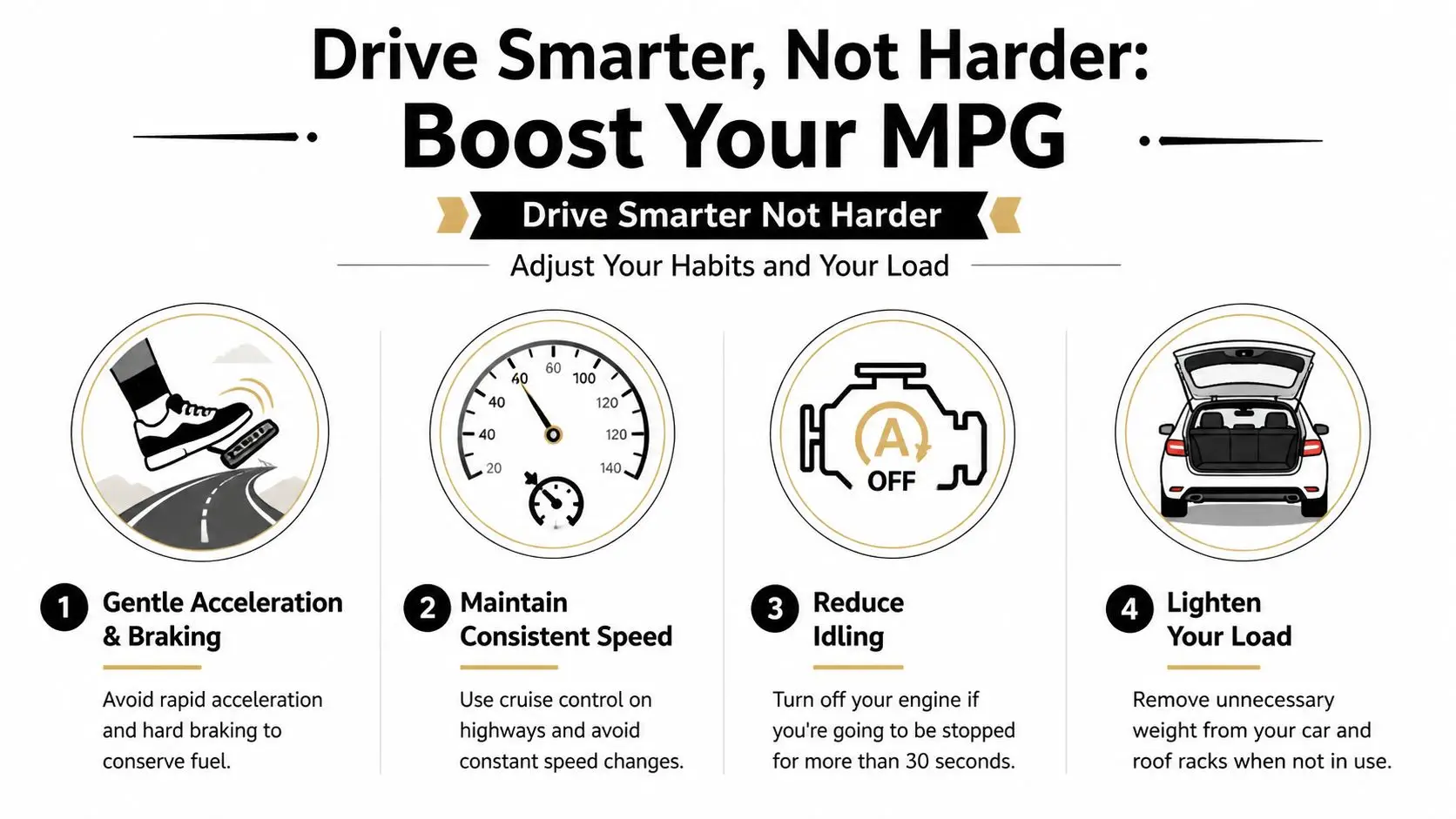
Drive Smarter Not Harder Adjust Your Habits and Your Load
Some of the cheapest fuel-efficiency improvements don't involve parts at all. They come from how you drive the car and what you're asking it to carry.
In Plano, that matters. Repeated stop-and-go traffic, long idle periods in parking lots, and quick highway merges make older cars burn more fuel than they need to. The driver can either add stress to that situation or smooth it out.
Smooth driving saves more than people expect
Older cars respond best to calm inputs. Hard acceleration dumps in fuel. Last-second braking wastes momentum you already paid for. Constant speed changes on the highway make the engine keep catching up.
A better routine looks like this:
- Accelerate progressively: Give the engine time to build speed instead of stabbing the throttle.
- Look ahead in traffic: If a light is turning red, coast early instead of racing toward it.
- Hold steady speed when possible: Older drivetrains like consistency.
- Cut unnecessary idling: If the car will be parked for a bit, don't let it sit and burn fuel just to stay running unless conditions require it.
Clean out the extra weight
A lot of older cars become rolling storage units. Toolboxes, sports gear, old parts, bottled water cases, and trunk clutter add up. If you don't need it every day, don't carry it every day.
According to Mobil's fuel-economy guidance, removing 50 kg, or about 110 pounds, can save approximately 2% in fuel consumption in some situations, as noted in this vehicle maintenance article.
That doesn't mean stripping the car for every trip. It means being honest about what lives in the trunk, rear seat, cargo area, or on the roof for no good reason.
Roof racks, carriers, and junk in the trunk don't look dramatic. On an older car, they still make the engine work harder.
A simple way to decide what to do first
I like to sort fuel-saving actions by cost, effort, and likely return. That keeps people from spending real money before trying the free or cheap fixes.
Fuel Efficiency Actions Cost vs. Benefit
| Action | Estimated Cost | Potential MPG Gain | Effort Level |
|---|---|---|---|
| Smoother acceleration and braking | Low | Can help reduce wasted fuel | Low |
| Reduce idling | Low | Can help, especially in local driving | Low |
| Remove about 110 lbs of unnecessary weight | Low | About 2% fuel-consumption savings in some cases | Low |
| Tire pressure check and correction | Low | Often noticeable over time | Low |
| Alignment service | Moderate | Helps when the car is dragging or scrubbing tires | Medium |
| Basic tune-up maintenance | Moderate | Often worthwhile if overdue | Medium |
| Professional ECU remap | Higher | More specialized, larger upside on suitable vehicles | High |
This kind of table helps you prioritize. Free driving-habit changes come first. Weight reduction is next because it's simple. Mechanical work comes after you've corrected what doesn't cost much.
The habit side of fuel economy
Drivers sometimes focus so hard on the car that they ignore the person behind the wheel. That's a mistake. A well-maintained older car driven aggressively will still waste fuel. A reasonably maintained one driven with patience often does much better than people expect.
If you want to know how to improve fuel efficiency in older cars without turning the whole thing into a project, start with your right foot, your stopping distance, and the junk you're hauling around for no reason.
Sensible Upgrades for Modern Efficiency
A lot of older cars in Plano hit a point where the cheap fixes are already done, the driving habits are better, and fuel economy is still disappointing. At that stage, the smart move is to spend money only where the return makes sense. The goal is not to chase every upgrade on the internet. The goal is to fix the specific system that is wasting fuel, then compare the repair cost against how many miles you drive each month.
Start with symptoms, not parts
Older fuel-injected engines can lose efficiency in small ways that add up. An oxygen sensor may respond slowly. Injectors may not spray cleanly. Fuel trim can drift rich enough to hurt mileage without setting an obvious warning light right away. The car still runs, but it uses more fuel than it should.
That is why diagnosis pays for itself.
If mileage dropped, cold starts got rougher, or throttle response feels lazy, check the fuel-control side before buying random tune-up parts. A good example is fuel-system service. It helps some cars and does very little for others. This overview of what a fuel system cleaning is explains when the service matches the problem.
ECU tuning has upside, but only for the right car
Some older vehicles respond well to ECU remapping. Some do not. The best candidates are electronically controlled, fuel-injected cars with a healthy engine, no unresolved drivability problems, and an owner who drives enough miles to recover the cost.
I tell customers to run a simple calculator before spending that money. Estimate your current MPG, your realistic MPG improvement, your monthly miles, and local fuel cost. Then compare the projected savings to the tuning bill. If the car is a weekend cruiser, the math is usually weak. If it is a daily commuter running across Plano, Richardson, and Dallas five days a week, the payback can be a lot more reasonable.
A remap also carries trade-offs. A poor tune can create spark knock, drivability issues, or emissions problems. Even a good tune may not be worth it on a tired engine or an older automatic that already spends too much time in the wrong gear.
Heat management helps the owner more than the MPG number
Texas summer driving changes behavior. When a cabin is baking in a parking lot, drivers idle longer, blast the A/C harder, and put off errands until the engine is already running. Reducing cabin heat does not fix a fuel-control problem, but it can make the car easier to live with and cut some waste around the edges.
If you are comparing comfort upgrades, this guide to ceramic tint benefits for your car is a useful place to start.
Which upgrades usually make financial sense
Use the upgrade only if the car and your driving pattern support it.
| Upgrade or service | Best fit | Cost-benefit view |
|---|---|---|
| Oxygen sensor testing or replacement | Fuel-injected cars with mixture symptoms, poor mileage, or aging sensors | Often a good value when testing confirms a slow or failed sensor |
| Fuel-system cleaning | Cars with deposit-related drivability concerns | Worth paying for when symptoms point there, easy to skip when they do not |
| ECU remap | Healthy EFI vehicles driven often enough to recover the cost | Bigger upside, but only if tuning is done correctly and the math works |
| Heat-reducing upgrades | Daily drivers parked in direct sun | Comfort-focused, with small indirect fuel savings at best |
One practical note. Express Lube & Car Care handles diagnostics and fuel-system-related maintenance for older vehicles that have mileage complaints tied to drivability symptoms, not just normal wear. That can be the better first spend before you put money into advanced tuning.
DIY vs Pro When to Visit Our Plano Shop
Some fuel-saving work is simple enough to do at home with a tire gauge, basic hand tools, and a little patience. Some jobs can go sideways fast if you don't have scan data, alignment equipment, or experience with older systems. Knowing the difference saves money and keeps you from creating a bigger problem.
Good DIY jobs
These are realistic for most owners who are careful and methodical:
- Check and adjust tire pressure: Fast, cheap, and worth doing regularly.
- Remove extra weight from the car: Trunk clutter, unused cargo, and roof accessories are easy wins.
- Inspect service records: Figure out what maintenance is overdue before buying parts.
- Replace an air filter when needed: Just remember that on many fuel-injected older cars, it won't improve MPG even though it may help acceleration.
- Watch for symptoms: Pulling, rough idle, hesitation, or hard starting all help point the next repair in the right direction.
Bring it to the pros
These jobs usually need tools, testing, or technical judgment:
- Wheel alignment work: You can't eyeball this accurately enough for good results.
- Fuel-system diagnosis: The symptom may be injectors, pressure, airflow, or sensor feedback.
- Oxygen sensor diagnosis and replacement: The part matters, but so does knowing whether it caused the problem.
- Advanced ignition and ECU tuning: This is not guesswork if you want the engine to stay healthy.
- Drivability issues with no obvious cause: That's where live data and experience pay off.
A lot of people also overlook the cosmetic side of efficiency ownership. A clean, decluttered, well-kept vehicle is easier to inspect and maintain. If you want to see what thorough cleanup can do for a well-used car, these full detail high mileage vehicle results show why condition matters, especially when you want to spot leaks, worn trim, or neglected areas early.
When a shop visit makes sense
Bring the car in when the mileage drop comes with drivability symptoms, when tires show uneven wear, or when you know the vehicle is overdue for real service and you want an honest inspection instead of random parts replacement.
At our Plano shop, the work most relevant to fuel economy is usually straightforward. Oil changes, inspections, tune-up checks, alignment-related concerns, and drivability diagnosis tell you more than guessing ever will. The advantage for busy drivers is that you don't need to schedule your life around it. We handle walk-in service, and the technicians are ASE-certified.
We also keep routine savings available for drivers who are trying to maintain an older car without overspending. That includes $20 off oil changes, additional discounts for military, first responders, and healthcare workers, $20 off batteries with the signature battery service, and $25 off oil changes on Ladies Day every Wednesday. If your fuel economy problem starts with neglected maintenance, using those offers can make catching up easier.
Frequently Asked Questions About Fuel Efficiency
A few questions come up over and over from older-car owners in Plano. Most of them boil down to the same concern. What works, and what just sounds good?
| Question | Answer |
|---|---|
| Does premium fuel improve gas mileage in an older car? | Only use the fuel grade the vehicle was designed for. Paying for higher octane doesn't automatically improve fuel economy if the engine doesn't require it. |
| Should I replace the air filter to improve MPG? | Maybe, but it depends on the engine type. On carbureted older vehicles, a clogged air filter can matter for fuel economy. On most fuel-injected older cars, a new filter helps maintenance and possibly acceleration, but not MPG. |
| Is an alignment really worth it for mileage? | Yes, when the car is pulling, wearing tires unevenly, or tracking poorly. Misalignment creates drag and can waste fuel while wearing out tires faster. |
| Can driving habits make a real difference? | Absolutely. Smooth throttle use, less idling, and carrying less weight often give noticeable everyday savings without buying parts. |
| Is ECU remapping safe? | It can be, when done professionally on the right vehicle after the engine is confirmed healthy. It isn't a shortcut for neglected maintenance. |
| What's the first thing I should check on an older car with poor mileage? | Start with overdue maintenance, tire condition, tire pressure, and obvious drivability symptoms. Those usually tell you whether the issue is basic upkeep or something that needs shop diagnostics. |
Older cars can still be efficient enough to live with. The owners who get the best results usually aren't chasing gimmicks. They're fixing what causes waste, one system at a time.
If your older car is using more gas than it should, Express Lube & Car Care can help you sort out whether the fix is simple maintenance, tire and alignment work, or a drivability issue that needs diagnostics. The shop serves Plano drivers with walk-in convenience, ASE-certified technicians, and practical services that matter for real-world fuel economy, from oil changes and inspections to deeper repair work.