

You merge onto US-75, settle into the lane, loosen your grip on the wheel, and the car starts drifting right again. Not hard enough to feel like an emergency. Just enough that you keep correcting it every few seconds.
That’s how this problem usually starts.
Most drivers describe it as a nuisance first. The steering wheel doesn’t sit quite right. The car won’t track straight. On the Dallas North Tollway or during a daily Plano commute, it turns into a tiring drive because you’re constantly making small corrections. What feels minor can point to tire wear, brake drag, suspension wear, or alignment trouble that will cost you more if you ignore it.
A car pulls to the right for a reason. Sometimes the fix is simple. A low tire, a worn tire, or a brake issue can do it. Sometimes the cause is deeper, especially after a pothole hit or curb impact. If you’ve already noticed other clues like an off-center steering wheel, uneven tread wear, or a change after a bump, it’s worth reading the warning signs in this guide to signs your car needs alignment.
The good news is that you don’t need to guess. You can narrow this down at home in a few minutes, then decide whether it’s safe to keep driving or time to get it checked.
That Gentle Tug on the Steering Wheel
The tricky part about a right pull is that it can feel normal for a while. Drivers get used to holding a little pressure on the wheel. They adjust without thinking about it. Then one day they notice the outside edge of a front tire is wearing faster, or the car darts more when braking, or the steering wheel is no longer centered.
That small tug usually means one side of the car is creating more drag or more steering force than the other. The cause might be mechanical, or on newer vehicles, electronic. Either way, the car is telling you it isn’t rolling evenly.
A healthy car should track straight on a level road with only light driver input. If it won’t, something has changed.
The practical goal isn’t just comfort. It’s protecting tire life, keeping braking predictable, and avoiding the kind of repair that starts small and gets expensive because it wasn’t diagnosed early.
Your Five-Minute Driveway Diagnosis
You can learn a lot before a shop ever touches the car. Don’t start with parts. Start with the easy checks that separate a simple issue from one that needs a lift and measuring equipment.
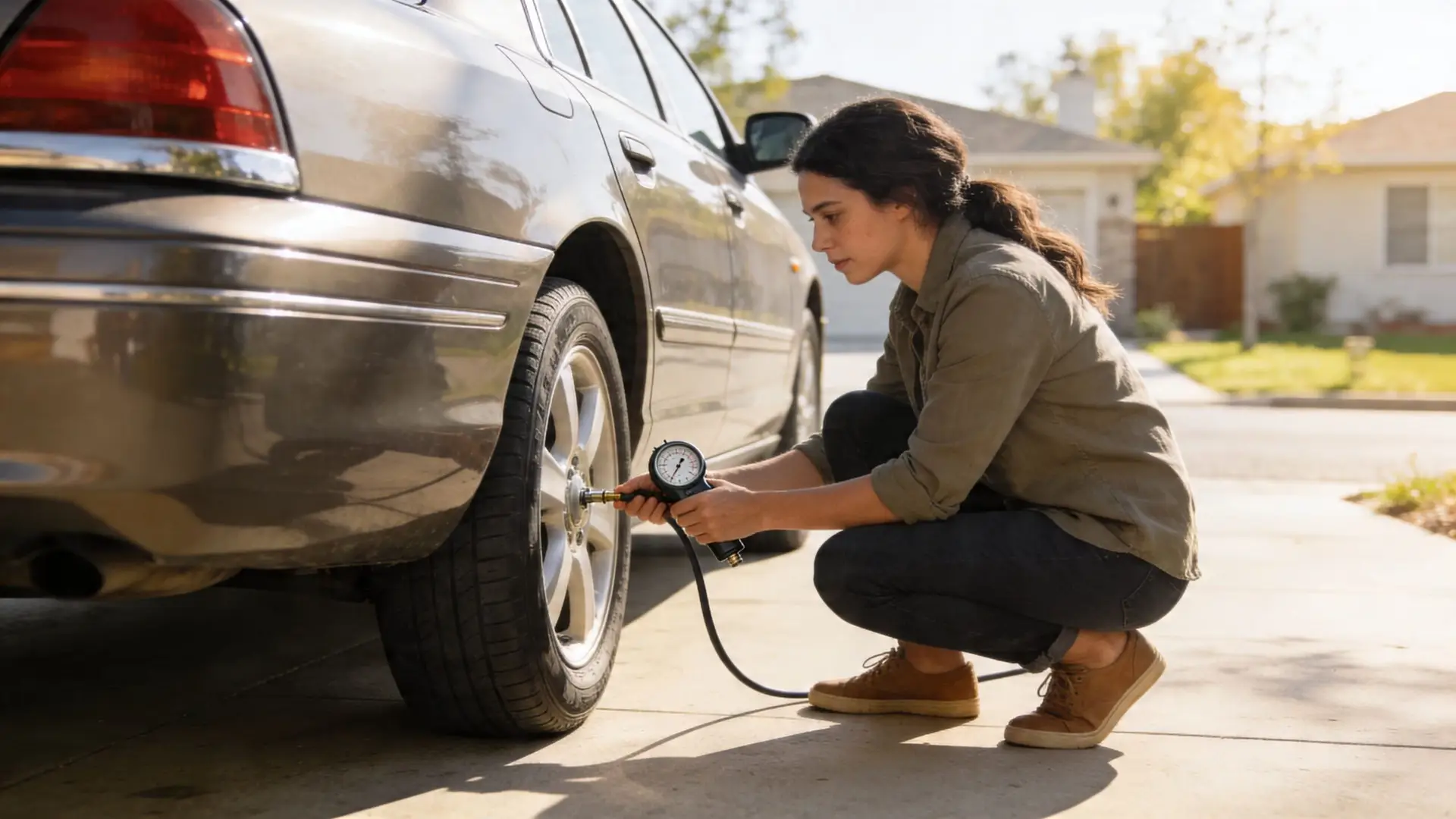
Check tire pressure first
Tire pressure is the fastest thing to verify, and it matters more than many drivers think. Use a gauge when the tires are cold and compare each tire to the pressure listed on the driver’s door jamb sticker, not the number molded into the tire sidewall.
If one front tire is low, that tire creates more rolling resistance and can make the car drift toward that side. If the right front is low, the car may pull right. If the left front is low, the pull can feel less obvious at first because the steering wheel correction masks it.
Use this quick order:
- Read the door sticker. That’s the vehicle spec.
- Check all four tires. Don’t stop at the fronts.
- Inflate evenly. Match the sticker, then recheck.
- Drive again on a flat road. See whether the pull changes.
If the steering also feels heavier or inconsistent at low speed, it’s smart to rule out steering assist issues too. A basic review of how to check power steering fluid can help on vehicles that still use hydraulic power steering.
Look at tread wear, not just tread depth
Tires tell stories. You don’t need a tread depth gauge to spot the obvious ones.
Walk around the car and inspect the inner and outer edges of each tire. Turn the front wheels if needed so you can see better. Run your palm lightly across the tread blocks. You’re looking for wear that is uneven from side to side or feels jagged in one direction.
Common patterns to notice:
- Outer-edge wear means the tire is scrubbing on that shoulder more than it should.
- Inner-edge wear often points to angle problems you won’t fix with air alone.
- Feathering feels smooth one way and sharp the other. That usually means the tire has been dragged slightly sideways as it rolls.
- Cupping looks scalloped or patchy and often comes with noise or vibration.
Write down which tire has the issue. “Front right outer edge worn” is useful information. “Tires look bad” isn’t.
Practical rule: If one tire looks much different from the tire on the other side of the same axle, don’t ignore it. That comparison often reveals the problem faster than looking at one tire by itself.
Check for brake heat after a short drive
A sticking brake caliper can create a steady pull, and many drivers miss it because the car still stops. The clue is heat.
Take a short drive without heavy braking. Park safely, then carefully feel near each wheel area for heat. Don’t touch the rotor directly. You’re checking whether one wheel is noticeably hotter than the others.
A hotter right front often suggests brake drag on that corner. You may also see heavier brake dust on one wheel. If the car pulls more during braking than cruising, move brake issues higher on your suspect list.
This short video gives a useful visual of what to inspect before booking service.
Do one careful road test
Find the flattest, safest road you can. Road crown can make any car drift slightly right, so don’t judge the car on a strongly sloped neighborhood street.
Pay attention to these differences:
- Constant drift at all speeds often points toward tire, alignment, or suspension issues.
- Pull only when braking raises suspicion for brake drag or uneven brake force.
- Pull only on acceleration often points somewhere else entirely, which matters a lot on front-wheel-drive vehicles.
- Steering wheel off-center but car tracks straight after correction usually suggests geometry is off even if the pull feels mild.
What your driveway check can and can’t do
These checks help you gather clues. They don’t replace measuring camber, toe, caster, brake drag, or suspension play. What they do well is save time.
If tire pressure fixes the issue, great. If you find obvious tire wear, one hot wheel, or a pull pattern tied to braking or acceleration, you’ve already narrowed the diagnosis and avoided random part swapping.
Decoding the Four Main Causes of Vehicle Pulling
Most right-pull complaints come down to four systems. Alignment, tires, brakes, and suspension. A good diagnosis separates them instead of treating them as one big category.
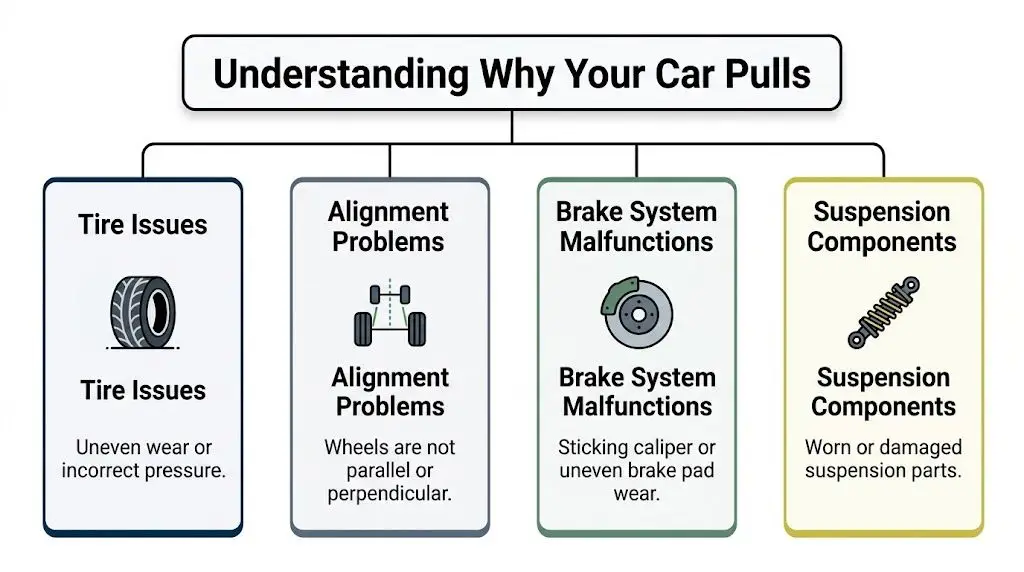
Alignment is the first suspect for a reason
Misaligned wheels are the number one cause of a car pulling to one side. They can make tires wear up to 50% faster, increase fuel use by as much as 10%, and many alignment problems start after pothole hits. The same source notes the AAA Foundation estimates over 500,000 pothole-related vehicle damages annually in the U.S. (wheel alignment explanation and pothole impact details).
Alignment sounds technical, but the basic idea is simple. The wheels must point the right direction and sit at the correct angles so the car rolls straight without scrubbing the tires.
The three angles that matter most are:
- Toe. Whether the tires point slightly inward or outward when viewed from above.
- Camber. Whether the top of the tire leans inward or outward when viewed from the front.
- Caster. The steering axis angle that helps the wheel self-center.
Think of a shopping cart with one crooked wheel. It still rolls, but it doesn’t roll cleanly. A car with poor toe or camber does the same thing, just with more weight and more expensive consequences.
There’s another detail many drivers never hear. A car can still pull even when each front wheel is technically “within spec” if the left and right camber values are imbalanced. The lateral force from that imbalance explains some pull complaints that pass a quick alignment glance. For a plain-English overview of related service work, this guide to wheel alignment and balancing is a useful companion read.
Tires can cause a pull all by themselves
Drivers often assume, “If it pulls right, it needs an alignment.” That’s not always true.
A tire can create its own sideways force because of construction variation. In the trade, one of the important tire-related causes is conicity. The tire acts a bit like a cone rolling on a surface, and the car drifts even if the alignment settings aren’t the root problem.
Other tire-related causes include uneven wear, mismatched tread patterns, internal belt problems, and major pressure differences. The key point is this: if the tire itself is the cause, an alignment won’t cure it.
If a vehicle starts pulling right after new tires, don’t assume the alignment changed overnight. Check the tires before you sell alignment as the answer.
Brake drag creates a directional force
Brake problems usually show themselves during braking, but not always. A sticking caliper, frozen slide pin, or restricted brake hose can keep one wheel dragging even when the driver is off the pedal.
That drag acts like someone is lightly applying the brake on one side. The car doesn’t roll freely, the steering feels biased, and that corner often runs hotter. Brake pull can be subtle at first, especially on short city trips.
If you’re seeing uneven pad wear, it helps to understand the usual mechanical patterns behind it. This breakdown of what causes uneven brake pad wear lines up closely with what technicians find on pull complaints.
Suspension wear changes the car under load
Suspension parts locate the wheels. Once those parts wear, alignment doesn’t stay where the machine set it.
Common trouble spots include:
- Ball joints
- Tie-rod ends
- Control arm bushings
- Strut mounts
- Wheel bearings
A worn bushing may let the wheel shift rearward or sideways under braking. A weak ball joint may let the angle change over bumps. A worn wheel bearing can add drag and noise while also affecting how the car tracks.
This is why some vehicles feel fine in the bay and vague on the highway. Static measurements don’t always tell the whole story when parts move under load.
When Your Car Only Pulls Sometimes
A lot of drivers get thrown off because the pull isn’t constant. The car behaves one way leaving a stoplight, another way during braking, and another way at highway speed. That pattern matters.

Pulls only when accelerating
If the vehicle pulls right only when you get on the throttle, especially in a front-wheel-drive car, think torque steer before you think alignment. This kind of pull is common enough that it accounts for 25% of pull-related shop visits, and it’s misdiagnosed as alignment 40% of the time according to the cited mechanic survey summary in this torque steer diagnostic reference.
Why it happens is straightforward. As power loads the driveline, the engine, transmission, mounts, axles, and suspension all react. If a mount is weak or one side of the suspension flexes more than it should, the car steers under load.
In hot areas like Plano, degraded engine and transmission mounts are a frequent contributor. If the pull disappears when you lift off the gas, alignment moves down the list.
Pulls only when braking
That’s a different conversation.
A braking pull points first toward brake force imbalance or suspension movement under deceleration. A sticking caliper on the right can drag the car that direction. A worn control arm bushing can also let the wheel shift as weight transfers forward, which changes the vehicle’s path only during braking.
A car that tracks straight while cruising but darts right on the brake pedal deserves attention sooner, not later.
Pulls mostly at highway speed
When the complaint starts with “It’s fine around town, but on the highway it wanders right,” I think about dynamic issues. Tire shape, tire balance, road crown sensitivity, and suspension geometry under load become more important at speed than they are in a parking lot.
Highway-speed pull can also expose alignment imbalance that doesn’t feel dramatic around town. The car may seem calm at low speed, then demand constant correction once the loads rise and the suspension settles differently.
Pull changes with the road
Some roads will fool you. Strong crown for drainage biases vehicles right. If the car only does it on one familiar route, test it somewhere flatter before you assume a repair is needed.
If it pulls on multiple roads and under the same conditions, it’s probably the vehicle, not the pavement.
The Ghost in the Machine Modern Electronic Causes
On newer vehicles, pulling isn’t always mechanical. That’s the part many standard guides miss.
If your vehicle is 2015 or newer, ADAS can be the hidden cause. Service bulletins and mechanic forum reports indicate uncalibrated sensors contribute to 15% to 20% of persistent pull complaints even after a correct alignment, and the issue is becoming more common with over-the-air software updates according to this ADAS-related pulling overview.
What ADAS has to do with a right pull
Modern cars use systems like lane keeping assist, lane departure correction, electronic steering assist, and steering angle sensors. When those systems are calibrated correctly, they help. When they aren’t, they can create a strange artificial steering input that feels like the car wants to move right.
Drivers often describe it as “the alignment was done, but it still doesn’t feel right.”
That complaint deserves a different line of thinking if the vehicle recently had:
- Suspension or steering repair
- Wheel alignment
- A collision, even a minor one
- A windshield replacement on vehicles with forward-facing cameras
- A battery disconnect or software update, depending on the model
How electronic pulling feels different
Mechanical pulls are usually consistent in a physical way. You feel drag, tire scrub, brake bias, or steering angle change with load. Electronic pulls can feel less predictable. The steering may feel normal one moment and lightly guided the next.
Sometimes drivers only notice it on marked roads at cruising speed. Sometimes they feel a subtle steering correction that disappears when driver-assist features are switched off.
That doesn’t mean every right pull on a newer car is electronic. It means you shouldn’t keep chasing mechanical fixes if the hardware checks out and the complaint remains.
On a newer vehicle, a “perfect alignment” doesn’t end the diagnosis if the steering still feels wrong.
What doesn’t work
Guessing doesn’t work here. Neither does replacing suspension parts without a reason. If the car recently had alignment or front-end work and still drifts, sensor calibration and steering-angle data need to be part of the conversation.
Modern diagnostics matter. Not because electronics are mysterious, but because they need the right scan tools and calibration procedure instead of more trial and error.
How Our Plano Technicians Pinpoint the Problem
A correct diagnosis follows an order. Shops get into trouble when they skip steps and go straight to alignment numbers or parts replacement.
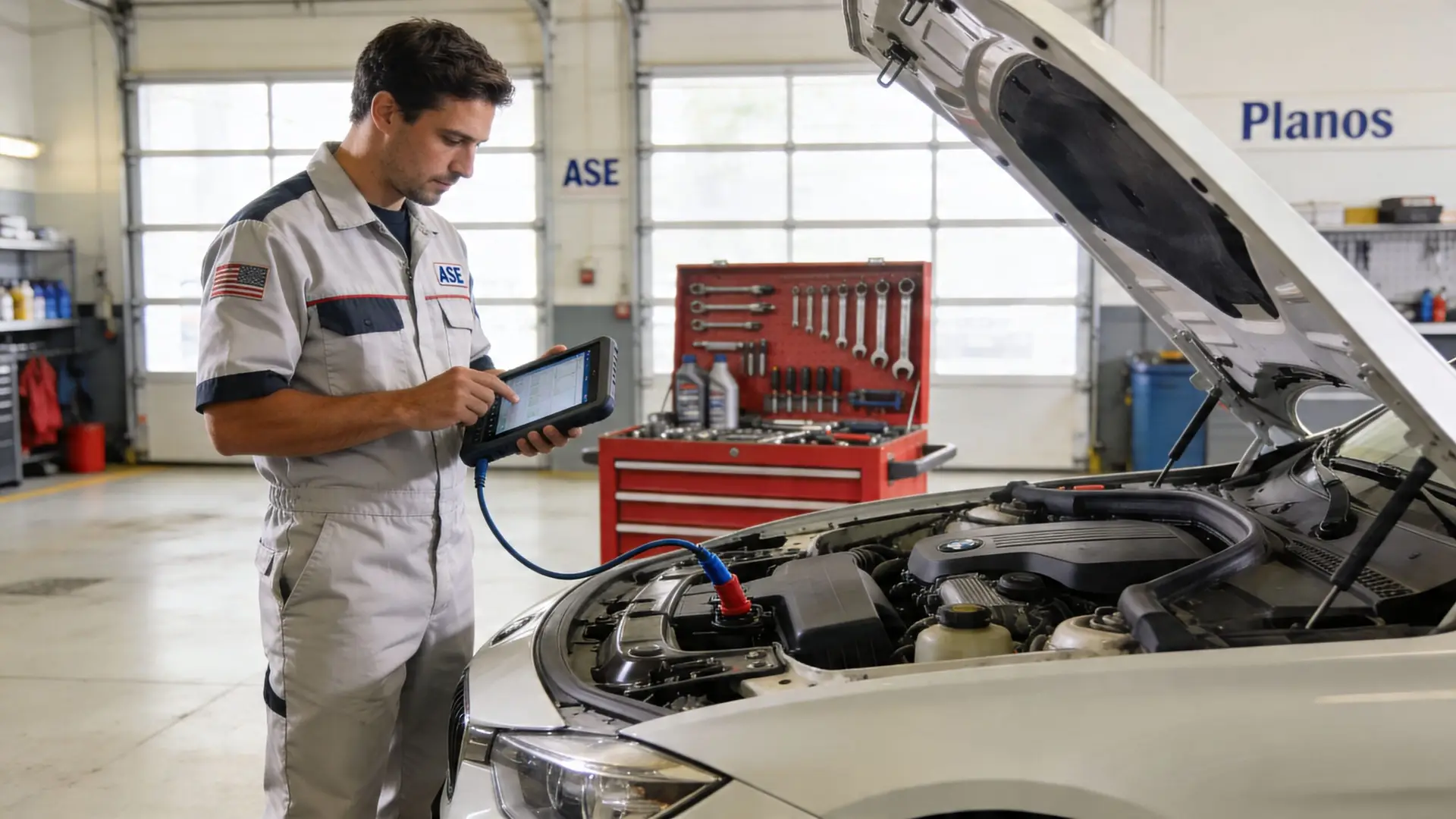
The first step is the conversation
A technician should ask when the pull happens. All the time, under braking, only on acceleration, after a tire replacement, after hitting a pothole, or only on certain roads. Those details change the path of the diagnosis.
Then comes a verification drive. You can’t fix what you haven’t duplicated. A good road test checks steering wheel position, road sensitivity, braking behavior, and whether the complaint changes with throttle.
On-lift inspection comes before final conclusions
Once the vehicle is up, the inspection needs to be physical, not just digital. That means checking for looseness in steering and suspension parts, looking at bushings, watching for torn boots, inspecting brake hardware, and comparing tire condition side to side.
An alignment rack is useful. It is not a magic truth machine.
A vehicle with worn parts can show numbers that look acceptable when sitting still, then pull on the road because those parts shift under load. That’s why experienced techs don’t stop with the printout.
The tire conicity test prevents bad calls
One of the most valuable professional checks is the tire conicity test. The NHTSA diagnostic protocol says that if non-unidirectional front tires are swapped left to right and the pull direction reverses, the cause is the tire, not the alignment. That same protocol helps prevent misdiagnosis in 30% to 40% of pull complaints according to the NHTSA tire conicity bulletin.
That matters because an unnecessary alignment wastes money and can send the settings away from where they should be if a technician tries to “align out” a tire problem.
Shop-floor advice: If a pull complaint hasn’t had a before-and-after road test with the tires evaluated properly, the diagnosis isn’t finished.
What a useful estimate should tell you
A good repair recommendation doesn’t just name a part. It should tell you what failed, why that failure causes the pull, how urgent it is, and whether a simpler check ruled out other causes first.
Here’s a plain-language summary of the usual suspects.
| Potential Cause | Safety Urgency | Typical DIY Fix | Estimated Pro Repair Cost |
|---|---|---|---|
| Low or uneven tire pressure | Moderate | Adjust all four tires to the door-sticker spec | Varies by vehicle and service needed |
| Tire conicity or internal tire issue | Moderate | None beyond checking pressure and condition | Varies by tire and labor |
| Wheel alignment issue | Moderate to high | None accurately at home | Varies by vehicle and whether worn parts must be replaced first |
| Sticking brake caliper or brake drag | High | No reliable DIY fix beyond symptom check | Varies by brake parts and related service |
| Worn suspension or steering parts | High | Visual check only | Varies by failed component and alignment needed after repair |
| ADAS or steering-angle calibration issue | Moderate to high | None without proper tools | Varies by system and calibration procedure |
Notice what’s missing from that table. Guesswork. That’s what costs drivers money.
Drive Straight and Safe Your Next Step
If your car pulls to the right, don’t treat it like a harmless quirk. A steady drift can shorten tire life, waste fuel, and make the car less predictable when you need to brake or steer quickly. The longer it goes, the more likely one problem turns into several.
The smart approach is simple. Start with the driveway checks. Confirm tire pressure, inspect tread wear, note whether the pull happens during braking or acceleration, and pay attention to any heat or drag at one wheel. Those clues can save time and help you explain the problem clearly.
After that, let the diagnosis get more precise. Some issues are obvious. Others need a road test, an on-lift inspection, alignment measurement, tire swapping, or electronic system checks. That’s especially true on newer vehicles where mechanical and electronic causes can overlap.
If you manage work vehicles or just want to understand how mobile support fits into the bigger maintenance picture, this overview of an on-site mechanic is a practical read. It’s useful for thinking through convenience versus shop-based diagnostics when a problem affects drivability.
The bottom line is this. If the car won’t track straight, something is off. You don’t need to panic, but you also shouldn’t keep correcting the wheel for weeks and hope it fixes itself.
If your car pulls to the right and you want a clear answer without the runaround, visit Express Lube & Car Care. Their ASE-certified technicians handle quick diagnostics, alignments, brake and suspension repairs, and modern electronic troubleshooting under one roof. You can stop by without an appointment, get honest recommendations, and take advantage of current savings like $20 off oil change and additional services for military, first responders, and healthcare workers, $20 off batteries with the Express Lube Signature battery service, and $25 off oil changes on Ladies Day every Wednesday.